
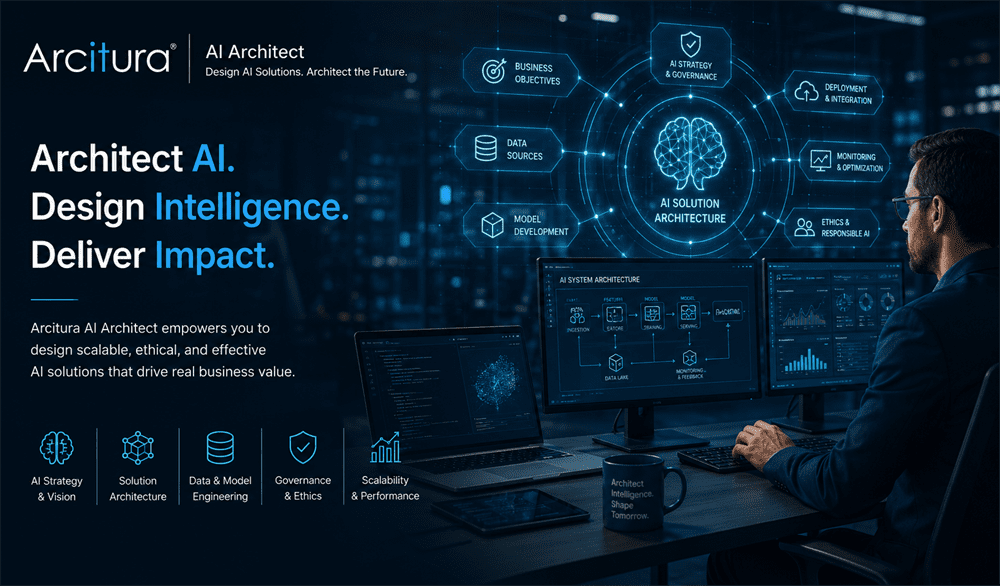
Arcitura Certified AI Architect
Complete Career & Exam Guide
Your authoritative resource for conquering the Arcitura AI Architect exam — salary insights, career paths, exam blueprint, and how killexams 1099 Scenario-Based Q&As give you the edge to pass on your first attempt.
Table of Contents
- What Is the Arcitura Certified AI Architect?
- Why This Certification Matters in 2026
- Salary & Compensation Data
- Market Demand & Career Opportunities
- Exam Details & Structure
- 5 Core Exam Domains Explained
- Eligibility & Prerequisites
- How killexams 1099 Q&As Help You Pass
- 30-Day Study Plan
- Expert Exam Tips
- Frequently Asked Questions
What Is the Arcitura Certified AI Architect?
The Arcitura Certified AI Architect is a globally recognized, vendor-neutral professional accreditation issued by Arcitura Education — one of the world's largest providers of progressive IT certification programs with over 100 course modules and 40+ certifications. The designation validates a specialist's deep proficiency in designing, building, and governing enterprise-grade AI systems.

AI Architects design the systems that power modern artificial intelligence — from predictive models to generative AI pipelines.
Unlike cloud-vendor credentials that focus on a single provider's ecosystem, the Arcitura AI Architect certification is platform-agnostic. Holders demonstrate mastery of both predictive and generative AI infrastructure, distributed computing paradigms, data management integration, and real-world architectural design patterns that work across any technology stack.
Part of the AI & Cloud AI Professional Academy
The AI Architect credential sits at the top of Arcitura's AI certification track. Passing the complete exam automatically awards both the AI Professional and the AI Architect certifications — delivering double value from a single examination session. Certificates and Credly/Acclaim digital badges are issued automatically upon passing.
Why This Certification Matters in 2026
Artificial intelligence has moved from experimental pilot to mission-critical infrastructure across every industry sector. Fortune 500 companies, government agencies, and fast-scaling startups alike are investing billions in AI systems — and they need architects who can translate business goals into production-ready AI pipelines. The Arcitura AI Architect certification is the credential that proves you can do exactly that.
Vendor-Neutral Authority
Recognized globally across AWS, Azure, Google Cloud, and on-premise environments — your skills travel with you regardless of employer stack.
Industry-Standard Rigor
Proctored by Pearson VUE at testing centers worldwide and via OnVUE online — the gold standard in certification delivery.
Double Certification Value
The complete exam grants both AI Professional and AI Architect accreditations simultaneously — maximizing your return on study time.
Generative AI Coverage
Syllabus explicitly covers generative AI architecture — the most in-demand skill category in the 2026 talent market.
AI Architect Salary & Compensation Data 2026
The financial case for pursuing the Arcitura AI Architect certification is compelling. According to current market data, AI Architects consistently rank among the highest-compensated technology professionals in the United States and globally.

AI Architect compensation consistently places professionals among the top earners in the global technology sector.
Salary by Experience Level
Top Paying Cities
- San Jose, CA — $226,939
- San Francisco, CA — $224,708
- New York, NY — $208,515
- Boston, MA — $200,670
- Seattle, WA — $198,889
Top Hiring Industries
- Technology Firms — 37%
- Professional Services — 24%
- IT Services — 18%
- Financial Services — 11%
- Healthcare & Life Sciences — 7%
The typical pay range per Robert Half's 2026 Salary Guide spans $142,750 to $196,750 for AI Architects, with significant upside for professionals who pair strong portfolio experience with a recognized vendor-neutral credential like the Arcitura AI Architect certification.
Market Demand & Career Opportunities
Demand for AI Architects has exploded as organizations accelerate AI adoption across every function. In Q1 2026 alone, there were over 35,445 AI-related positions posted across the United States — representing a 25.2% year-over-year increase from Q1 2024.

Enterprise AI adoption is driving unprecedented demand for certified AI Architects who can design production-grade intelligent systems.
Career Paths After Arcitura AI Architect Certification
Enterprise AI Architect
Design end-to-end AI infrastructure for Fortune 500 organizations, owning the technical blueprint for ML pipelines, inference engines, and AI governance frameworks.
Cloud AI Solutions Architect
Architect cloud-native AI workloads on hyperscalers, leveraging MLOps tooling and managed AI services to deliver scalable, cost-optimized solutions.
AI Research Architect
Bridge the gap between academic AI research and production deployment — translating novel model architectures into enterprise-ready systems.
Generative AI Architect
Specialize in LLM-powered agentic workflows, RAG architectures, fine-tuning pipelines and responsible AI guardrails — the hottest niche in 2026.
AI Governance Architect
Lead AI ethics, bias mitigation, model explainability and compliance programs — a rapidly growing role driven by emerging AI regulation.
Principal / Chief AI Officer
Progress to executive leadership, overseeing organizational AI strategy, capability building, and enterprise-wide transformation initiatives.
Exam Details & Structure
Complete Exam
- Coverage: All 5 Modules (Modules 1–15)
- Duration: 110 minutes
- Passing Score: 70%
- Prerequisites: None
- Awards: AI Professional + AI Architect
- Delivery: Pearson VUE / OnVUE online
- ESL Extension: Available on request
Partial Exam
- Coverage: Modules 13, 14, 15
- Duration: 110 minutes
- Passing Score: 70%
- Prerequisites: AI Professional Cert.
- Awards: AI Architect
- Delivery: Pearson VUE / OnVUE online
- Best for: Existing AI Professionals
Exam Delivery: Pearson VUE
Arcitura exams are administered globally through Pearson Professional Assessments (formerly Pearson VUE). You can register at any Pearson testing center worldwide or opt for OnVUE online proctoring, which allows you to take the exam from virtually any location at a time of your choosing — often on short notice. ESL candidates may purchase additional time by contacting Pearson customer service.
5 Core Exam Domains Explained
The complete AI Architect certification exam covers topics from five specialized modules, each carrying equal weight of 20%. Understanding each domain in depth is essential for achieving the 70% passing score.
| # | Domain | Weight |
|---|---|---|
| 01 | Fundamental AI Concepts & Business Drivers | 20% |
| 02 | AI Systems & Technology Architecture | 20% |
| 03 | Advanced AI Design & Implementation Patterns | 20% |
| 04 | AI Infrastructure & Integration Techniques | 20% |
| 05 | AI Architecture & Design Lab | 20% |
Domain 1 — Fundamental AI Concepts & Business Drivers (20%)
This domain establishes the foundational knowledge required before designing any AI system. Key topics include the AI taxonomy, the landscape of machine learning approaches, and the critical relationship between business objectives and AI solution selection.
- AI vs. Machine Learning vs. Deep Learning distinctions
- Predictive AI and Generative AI paradigms
- Business case development and ROI frameworks for AI
- Ethical considerations, bias, and fairness in AI systems
- Regulatory landscape and AI governance fundamentals
Domain 2 — AI Systems & Technology Architecture (20%)
Covers the technical architecture of end-to-end AI systems. Candidates must understand the components of ML pipelines from data ingestion through model training, validation, deployment, and monitoring in production environments.
- Model training loops and hyperparameter tuning
- Inference engine architecture and optimization
- Feature engineering and data preprocessing pipelines
- MLOps frameworks and CI/CD for AI models
- Distributed AI computing and parallelization strategies
Domain 3 — Advanced AI Design & Implementation Patterns (20%)
Tests mastery of reusable architectural patterns that solve recurring AI design challenges. This is where strong architects differentiate themselves — knowing not just how to build, but how to build elegantly.
- Microservices-based AI architectures
- Event-driven AI pipeline patterns
- Model versioning, A/B testing, and canary deployments
- Retrieval-Augmented Generation (RAG) design patterns
- Multi-model orchestration and ensemble strategies
Domain 4 — AI Infrastructure & Integration Techniques (20%)
Focuses on the infrastructure layer that supports AI workloads at scale — including compute optimization, data platform integration, and the connective tissue between AI systems and enterprise applications.
- GPU/TPU cluster design and resource management
- Data lake and data warehouse integration for AI
- API-first AI service design and RESTful/gRPC patterns
- Model serving infrastructure (batch vs. real-time)
- Security and access control for AI systems
Domain 5 — AI Architecture & Design Lab (20%)
The most challenging domain — scenario-based, case-study questions that simulate real enterprise architecture decisions. Candidates must apply knowledge from all four preceding domains to solve complex, multi-constraint problems.
- End-to-end AI solution architecture for given business scenarios
- Trade-off analysis between architectural approaches
- Performance optimization and scalability design decisions
- Risk assessment and mitigation in AI deployments
- Cost-performance optimization across cloud and on-premise environments
Eligibility & Who Should Pursue This Certification
Ideal Candidates
- Software architects transitioning to AI-first roles
- Data scientists seeking architecture-level recognition
- Cloud architects adding AI specialization
- ML engineers moving into systems design
- IT consultants advising on AI strategy
- Technical leads overseeing AI transformation programs
Recommended Background
- Familiarity with machine learning fundamentals
- Experience with at least one cloud platform
- Understanding of software architecture patterns
- Exposure to data engineering concepts
- Basic knowledge of model training workflows
- Arcitura's AI Architecture & Design course (strongly recommended)
How killexams 1099 Q&As Give You the Pass Advantage
Passing the Arcitura AI Architect exam demands more than reading textbooks. The exam's scenario-based Lab section in particular requires the kind of applied problem-solving fluency that can only be built through extensive practice with realistic, exam-style questions. This is precisely where killexams.com's AI-Architect practice test delivers measurable advantage.

killexams 1099 verified Q&As replicate the exact difficulty and format of the Arcitura AI Architect exam — building the exam-day confidence you need.
2026
What Makes killexams the Right Choice?
Scenario-Based Q&As
The 1099 questions include a substantial bank of scenario-based items — directly mirroring Domain 5's Lab section. Practice with realistic enterprise scenarios to build the decision-making fluency examiners are testing.
Continuously Updated
The killexams editorial team reviews and updates the AI-Architect question bank in response to syllabus changes and candidate feedback. Most recent update: June 24, 2026 — reflecting current exam objectives.
Multi-Device Compatible
Study on Windows, macOS, iOS, or Android. PDF is printable for commute study. The Online Test Engine runs in any browser. The Desktop Engine gives offline access with full analytics and progress tracking.
Detailed Explanations
Every question includes explanations that clarify the reasoning behind correct answers — building conceptual depth, not just surface-level memorization. Critical for scenario analysis tasks in the exam.
Readiness Analytics
The Test Engine tracks your performance by domain, identifying weak areas so you can focus your final study days strategically. Go into exam day knowing exactly where you stand.
Free Sample Available
Download a free sample PDF to evaluate question quality and format before purchasing the complete 1099-question set. Experience the material firsthand with no commitment required.
All 5 Exam Domains Covered
The killexams AI-Architect Q&A bank covers all five exam domains proportionally, ensuring balanced preparation across the complete exam blueprint:
- Domain 1: Fundamental AI Concepts & Business Drivers — conceptual and definitional questions
- Domain 2: AI Systems & Technology Architecture — component and pipeline questions
- Domain 3: Advanced AI Design & Implementation Patterns — pattern selection questions
- Domain 4: AI Infrastructure & Integration Techniques — infrastructure design questions
- Domain 5: AI Architecture & Design Lab — complex scenario and architectural decision questions
30-Day Study Plan to Pass the AI Architect Exam
A structured 30-day study approach — combining Arcitura's official courseware with intensive practice using killexams Q&As — gives most candidates the preparation depth needed to exceed the 70% passing threshold.
Daily Practice Routine (Recommended)
-
30 minutes: Review official Arcitura course module for the day's topic
-
45 minutes: Complete 40–50 killexams practice questions in the relevant domain
-
15 minutes: Review explanations for every question — correct and incorrect answers
-
10 minutes: Note weak areas in a study journal for weekend review sessions
Expert Tips to Pass the AI Architect Exam

Strategic preparation — not just hard work — is the key to conquering the Arcitura AI Architect examination.
Prioritize the Lab (Domain 5)
Domain 5 is the most complex. Spend proportionally more time on scenario-based questions in the killexams bank. Practice articulating why one architectural choice is better than another — not just selecting the right answer.
Master the Terminology
Arcitura exams use precise technical language. Know the difference between model training vs. inference, feature engineering vs. data preprocessing, and predictive vs. generative AI architecture patterns.
Time Management Is Critical
At 110 minutes for a comprehensive exam, pace matters. Use the killexams timed test engine to build speed and discipline. Flag uncertain questions, complete confident ones first, then return.
Understand Training vs. Production
Arcitura's official guidance emphasizes the relationship between training and production operational modes. Questions frequently test whether candidates understand how design decisions in training affect production behavior.
Use OnVUE for Scheduling Flexibility
Register via OnVUE online proctoring to choose your exact exam date and time. This flexibility lets you schedule immediately after completing your 30-day study plan while material is fresh.
Leverage the Free Sample First
Download the free killexams sample PDF before purchasing the complete set. Use it to calibrate your current knowledge level and identify which domains need the most preparation time.
Frequently Asked Questions
How long does the Arcitura AI Architect certification remain valid?
Arcitura certifications are awarded as permanent credentials with no expiration date. However, professionals are encouraged to pursue continuing education as the AI field evolves rapidly — especially given the pace of generative AI development.
How many questions are on the actual AI Architect exam?
While Arcitura does not publish a specific question count, the complete exam covers all five modules in 110 minutes and includes multiple-choice and scenario-based questions. Candidates should prepare thoroughly to meet the 70% passing threshold.
Related Articles
ABVM Exam Preparation Guide: Vascular Medicine Syllabus and Tips
Prepare for the ABVM Vascular Medicine certification exam with a comprehensive syllabus overview, vascular disease topics, diagnostic testin…
Read article →
HALM Exam Preparation Guide: Syllabus, Study Tips and Practice Tests
Prepare for the HALM Health Care Administration, Leadership and Management certification with a detailed syllabus overview, exam specific st…
Read article →
CDR RDN Exam Blueprint & Study Guide: Pass the Registered Dietitian Nutritionist Test
CDR Registered Dietitian Nutritionist (RDN) credentialing exam questions and answers in PDF and Test Engine for Practice. Learn the 4 domain…
Read article →