BCNS Board Certified Nutrition Specialist (CNS) Guide 2026
Advance Your Career in Advanced Clinical Nutrition & Functional Medicine
The Certified Nutrition Specialist® (CNS®) credential, administered by the Board for Certification of Nutrition Specialists (BCNS)—the certifying arm of the American Nutrition Association (ANA)—is recognized nationwide as the gold standard for advanced clinical nutrition professionals. As personalized health, functional medicine, and integrative care continue to reshape healthcare, the demand for highly trained nutrition scientists and clinical specialists has reached an all-time high.
Obtaining the CNS credential demonstrates advanced clinical competency, rigorous scientific expertise, and the legal authority in many jurisdictions to practice individualized nutrition therapy. This comprehensive guide breaks down the professional landscape, financial rewards, exam structures, and preparation tools needed to achieve certification on your first attempt.
Primary professional sectors for Board Certified Nutrition Specialists.
Career Outlook, Market Demand & Compensation
The transition toward preventative health and personalized nutrition has accelerated market demand for board-certified specialists. Unlike general nutritionists or health coaches, CNS practitioners hold advanced degrees (Master's or Doctorate) in nutrition or related clinical healthcare fields, allowing them to collaborate closely with medical doctors, osteopaths, and functional medicine practitioners.
High Earning Potential
The average compensation for a CNS ranges between $72,000 and $115,000+ annually, with experienced private practice consultants and corporate nutrition directors earning significantly higher salaries.
State Licensure Pathways
Passing the BCNS exam provides the requisite credential specified in many U.S. state statutes to obtain state licensure (e.g., LDN or CNS license) for autonomous practice and insurance reimbursement.
Diverse Career Settings
CNS professionals thrive in functional medicine clinics, integrative health centers, academic research institutions, supplement manufacturing, and telehealth platforms.
BCNS CNS Examination Architecture
The BCNS certification examination is a rigorous, computer-based test designed to evaluate advanced clinical competence. Candidates must demonstrate deep mastery across complex biochemical pathways, diagnostic interpretations, intervention protocols, and ethical practice.
| Core Exam Domain | Key Focus Areas | Weight |
|---|---|---|
| 1. Fundamental Biochemistry & Physiology | Macronutrient & micronutrient metabolism, energy pathways, cellular biology, enzyme kinetics. | ~25% |
| 2. Health Assessment & Clinical Data | Laboratory diagnostics, physical exams, nutritional status evaluation, genomics, biomarkers. | ~30% |
| 3. Personalized Nutrition Intervention | Therapeutic diets, botanical supplements, drug-nutrient interactions, functional care planning. | ~30% |
| 4. Professional Practice & Ethics | HIPAA compliance, legal scope of practice, ethical conduct, clinical documentation. | ~15% |
Visual distribution of BCNS certification exam domain weightings.
Proven Strategy to Pass the BCNS CNS Exam
Given the vast depth of advanced clinical biochemistry and complex case scenario questions, relying solely on general textbooks is often insufficient. To master the exam, candidates need a targeted, question-based learning approach that reinforces retention and tests clinical decision-making skills under timed conditions.
- Master Functional Biochemistry Pathways: Focus heavily on how nutrient cofactors influence the citric acid cycle, methylation, phase I/II liver detoxification, and mitochondrial function.
- Practice Advanced Diagnostic Interpretation: Ensure proficiency in evaluating comprehensive metabolic panels, organic acids tests, stool profiles, and nutrigenomic markers.
- Utilize Focused Question Pools: Solve realistic practice questions that simulate the actual exam's case-study format, question pacing, and conceptual depth.
Accelerate Your Preparation with Killexams BCNS-CNS Prep
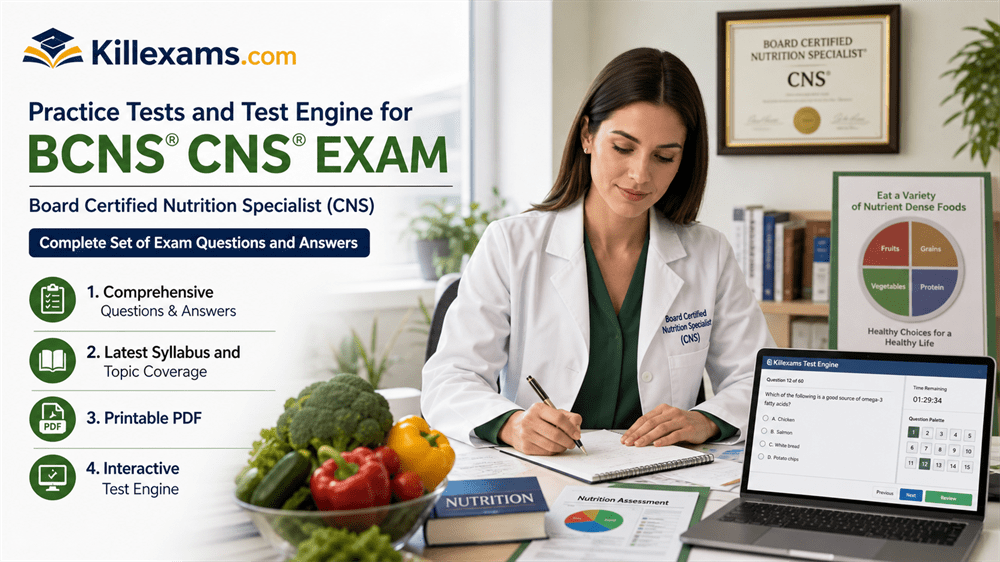
Preparing for the BCNS exam requires exposure to authentic question scenarios. Killexams provides a curated bank of 1140 Q&As specifically engineered to cover every core domain on the examination.
- 100% Comprehensive Coverage: Covers biochemistry, laboratory assessment, intervention planning, and clinical ethics in precise detail.
- Interactive Exam Simulator: Practice under realistic computer-based test conditions to build pacing and test-day endurance.
- Verified Explanations & Regular Updates: Content is continuously reviewed and aligned with current 2026 BCNS guidelines.
Frequently Asked Questions
Q: What degree is required to sit for the BCNS exam?
A: Candidates must hold a Master’s or Doctoral degree in nutrition or a healthcare field (such as MD, DO, DC, PharmD, or MSN) from a regionally accredited institution, accompanied by specific coursework in biochemistry, anatomy/physiology, and clinical nutrition.
Q: How many clinical practice hours are required for full CNS certification?
A: Candidates must complete 1,000 hours of supervised practice experience under a BCNS-approved supervisor in addition to passing the certification exam.
Q: How does Killexams' 1140 Q&A package help me pass?
A: The Killexams BCNS-CNS study package focuses directly on authentic question patterns, diagnostic interpretation scenarios, and complex biochemistry questions. Practicing with these 1140 questions ensures you master high-yield topics and gain confidence for test day.
Disclaimer: Certified Nutrition Specialist® (CNS®) and BCNS® are registered trademarks of the Board for Certification of Nutrition Specialists and the American Nutrition Association. Killexams is an independent educational prep provider and is not affiliated with or endorsed by the BCNS or ANA.