PCCN Certification Guide 2026: Salary, Career Growth & How to Pass the Exam
A complete roadmap for RNs and APRNs pursuing the AACN Progressive Critical Care Nursing (PCCN) credential.
What Is the PCCN Certification?
The Progressive Care Certified Nurse (PCCN) credential, administered by the American Association of Critical-Care Nurses (AACN), validates advanced competency for RNs and APRNs who care for acutely ill adult patients in step-down, telemetry, intermediate care, and progressive care unit (PCU) settings — patients who require close monitoring but not full ICU-level intervention.
The exam is built around the AACN Synergy Model for Patient Care, which frames nursing competency around matching patient needs to nurse capabilities, rather than testing simple recall of facts.
Why PCCN Certification Pays Off: Salary & Career Impact
Certification isn't just a professional milestone — it has measurable financial and career impact:
- Average salary: Progressive care nurses in the U.S. earn an average of approximately $89,000/year (around $43/hour), according to 2026 salary data, with variation based on location, experience, and facility.
- Certification differential: PCCN-certified nurses often see an additional $1,000–$3,500 per year in certification pay differentials, depending on employer policy.
- Career mobility: PCCN is frequently a stepping stone toward the CCRN (Critical Care Registered Nurse) credential, since AACN's exam frameworks overlap significantly — nurses who hold PCCN often find CCRN preparation considerably easier.
- Travel nursing advantage: Certified nurses are frequently more competitive for premium PCU and telemetry travel assignments.
- Magnet hospital alignment: PCCN certification supports hospitals' Magnet recognition standards, making certified nurses more attractive candidates during hiring and promotion cycles.

Career Opportunities After PCCN Certification
Holding a PCCN credential opens doors across several care settings and career tracks:
- Step-down and intermediate care unit roles
- Telemetry and cardiac monitoring units
- Charge nurse and unit leadership tracks
- Travel nursing contracts with PCU/telemetry specialization
- A credentialed pathway toward CCRN and further critical care specialization
PCCN Exam Structure
Candidates must hold an active, unencumbered RN or APRN license and meet clinical hour requirements (1,750 hours in the past 2 years, or 2,000 hours in the past 5 years, caring for acutely ill adults). The exam itself:
- 125 multiple-choice questions (100 scored, 25 unscored pretest items)
- 2.5-hour testing window
- Computer-based, typically at PSI testing centers or via live remote proctoring
- Passing generally requires roughly 68 correct answers out of 100 scored items
Exam Domain Weighting
| Domain | Weight |
|---|---|
| Clinical Judgment: Cardiovascular System | 27% |
| Clinical Judgment: Pulmonary System | 17% |
| Professional Caring and Ethical Practice | 20% |
| Clinical Judgment: Other Systems (Endocrine, Renal, GI, Neuro) | 20% |
| Clinical Judgment: Multisystem and Psychosocial | 16% |
How to Prepare: A Study Strategy That Works
- Prioritize by weight, not comfort. Cardiovascular and Pulmonary content carries the most points — study these first.
- Practice under timed conditions early. Build stamina for the 2.5-hour format weeks in advance, not the night before.
- Study for reasoning, not recall. Understand why the correct answer is right, and why distractors are wrong.
- Use the Synergy Model as your lens for scenario-based questions: what does this patient need, and which competency addresses it?
- Review consistently, not intensively. Short, regular sessions between shifts beat long infrequent cram sessions.
Why Practice Tests Matter for PCCN Preparation
Reading a textbook builds your knowledge base — but it can't expose you to the exam's actual reasoning style or question format. That's where structured practice testing adds real value.
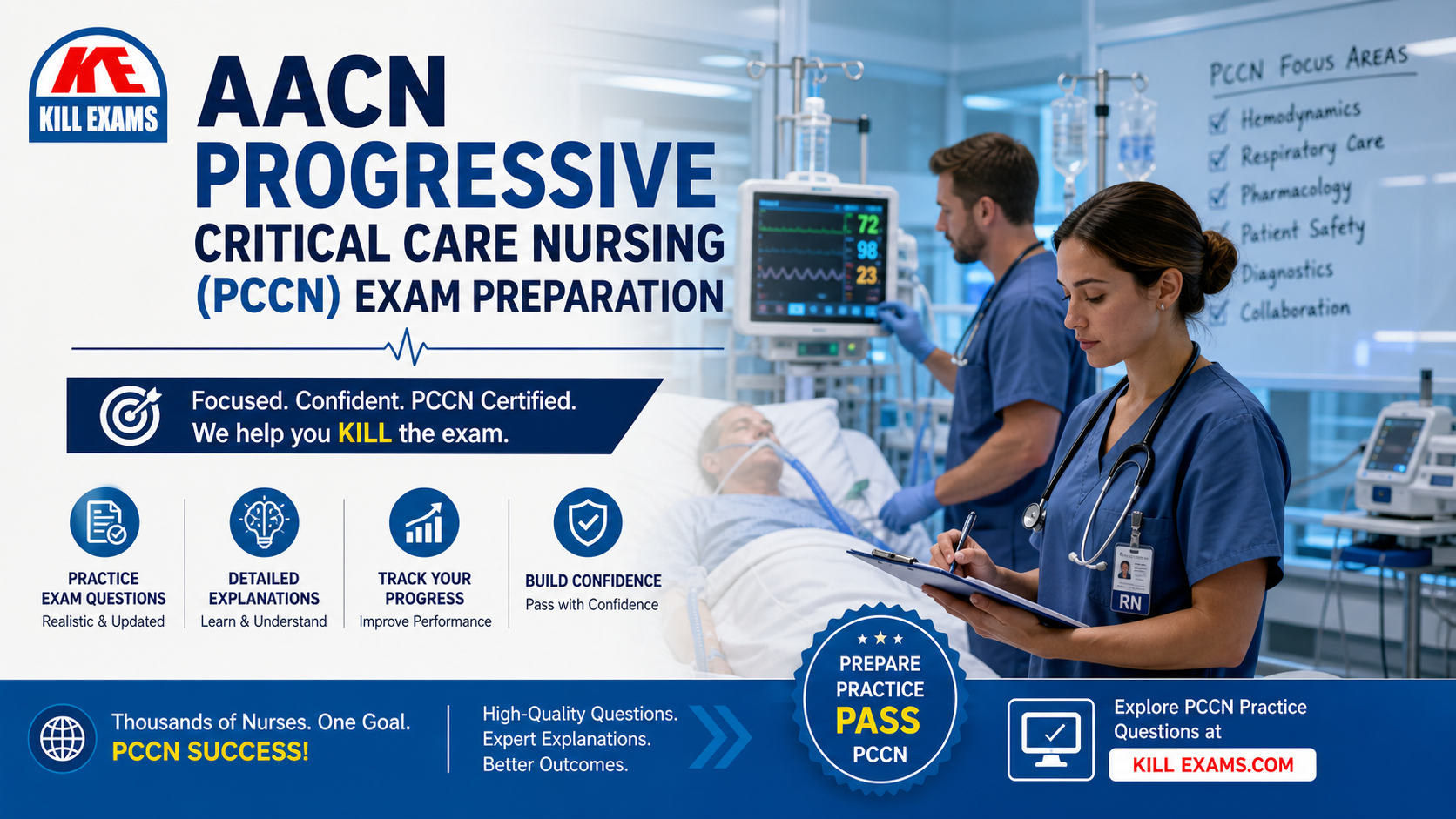
Killexams.com's PCCN practice test package includes 542 practice questions with detailed explanations, mapped to the exam's five core domains, along with an Online Test Engine and Desktop Test Engine that simulate timed, exam-style conditions — helping you track performance, identify weak areas, and build exam-day stamina.
Free Sample Questions PDF — preview the format before you commit
Pricing & Package Options — compare 3, 6, and 12-month update plans
Full Exam Detail Page — complete breakdown of domains, format, and package features
Killexams.com practice materials are developed and reviewed by subject-matter experts for accuracy and exam relevance, and do not contain content taken from the official AACN examination. These resources are intended to complement — not replace — official AACN study materials, including the PCCN Exam Handbook and core critical care nursing texts.
Final Thoughts
PCCN certification is more than a line on a resume — it's a validated signal of clinical judgment in one of nursing's most demanding environments, with real salary impact, career mobility, and a clear pathway toward further critical care specialization. The right preparation strategy — one built around the exam's actual weighting and reinforced with realistic practice — makes the difference between a stressful first attempt and a confident pass.
You already have the clinical experience. The right prep just helps you demonstrate it clearly, under pressure, on exam day.